Wednesday, January 15, 2020

Some excursions

After my shift yesterday, I had more energy than the few days prior and decided to trek out to Hueco Tanks. Hueco Tanks is about a half hour outside of El Paso, a big outcropping of volcanic rock that was once covered by limestone but has been exposed through a period of weathering over the last 34-38 million years. Hueco means hollow in Spanish, and the site is marked by the number of holes that allow water to collect during rains and remain long into the dry season.


Because Hueco Tanks acts as a sort of oasis, it is sacred to a number of Native American tribes and has a number of petroglyphs, but to be honest, I didn't see any.

As I walked out to my car from the ranger station, along saunters this guy:


He didn't have a care in the world, and when I was a bit too far away to take a picture, he took a squat and peed in the middle of the road!

I arrived at 4 and the sun set at 5:30, so I knew I was losing light and needed to be quick. But it was difficult to give it justice. Every ledge that I scrambled over made me want to scramble over another. There was a diversity of plant life nestled in the rock. People think that the desert is desolate, but this one actually has a lot of life, if you know how to look. A canyon towhee and Pyrrhuloxia rustled in the grasses below me as I balanced across a narrow passageway of rock. A Lincoln's sparrow scolded me from a bush as I made my way up a crevice.


As the sun was setting, I sat at the Hueco Prieta and watched a flock of juncos scratch the grass litter, seemingly oblivious to me. Deciding it was probably time to get to my car before dark and more importantly, before the gate closed, I made my way through a triangular crevice back to the road. It was so cozy, the temperature so perfect, that I almost could have slept there. You know, if it hadn't been for this sign.


The next day, I did some chores around CDR before being sent out to drop a family off at the bus stop and then drop food off at one of Annunciation House's other buildings, Oscar Romero. The building is named after an Archbishop of El Salvador who was killed after speaking out against social injustices, torture, and corruption in that country during civil unrest in the late 70's. He was more recently officially martyred and canonized by the Catholic Church.

This building houses longer term guests, and is right next to the largest Border and Customs Patrol detention center in El Paso. I learned that this location holds upwards of 800 detainees, and was the location that recently had some bad press when some of the people being held there went on a hunger strike and were force fed. It seemed that the guards even eyed me with suspicion as I drove away.

I finished off the day with a hike with a new friend of mine, Alison. It was a challenging, mostly uphill climb on scree, and we cut it close at the end- having to race to make it to the gate before it closed at 5pm sharp. But we did make it to a location of a spring, mostly dried up now, but allowing for more diverse plant life. There were two cotton wood trees that rustled in the wind, a beautiful sound against the silence of the mountain and the view of the valley.


Tuesday, January 14, 2020

Annunciation House

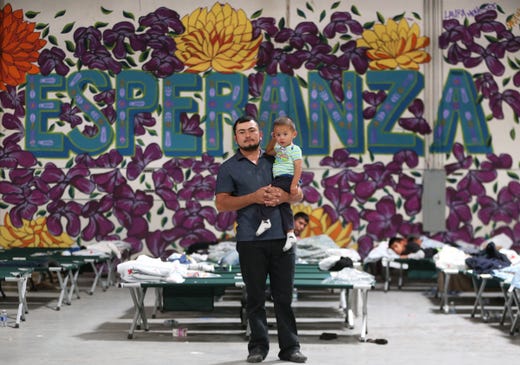
I arrived on Sunday morning at the unmarked warehouse where I was sent by Annunciation House. After the shooting in El Paso in 2019 that explicitly targeted Latinos, Annunciation House has been very discreet about its location. A long term volunteer, Pietro, came to lead me in through the large and labyrinthine warehouse that has been expertly decorated with murals from artists throughout the city.

Annunciation House is a privately funded Catholic mission that serves refugees from Latin America who cross the border at El Paso. The place that I am working is called Casa del Refugiado (CDR), which specifically serves families for short term stays, a mere stopover on their journey to somewhere else in the country.

All of the refugees who come to CDR first went through border detention and are dropped off by ICE. I have not yet delved into too much about the experience in detention with any of the guests at CDR, but I hope to learn more at some point.

Generally, people apply for asylum in Juarez, across the border, and wait until their turn is called. Especially since the Migration Protection Protocols, or the "Remain in Mexico policy", this is ICE's preferred method for those who are seeking asylum. Sometimes, people try to expedite the process by crossing the Rio Grande on foot. These people not only are caught but want to be caught, because this forces ICE to place them in detention and to begin the bureaucratic asylum process.


People at Annunciation House state that the people who come through their doors are sometimes fleeing extreme violence and persecution. I am sure that this is sometimes true, but I think that the following quote by a respected local reporter is more true. "It's pretty clear that most of (people crossing the border) don't meet the traditional definition of asylum seekers," states Robert Moore of El Paso Matters.  "Most of them at the root are trying to make lives better for their families. The challenge in Central America in particular becomes that you have all these issues of violence, and government impunity, and corruption, and gangs, and climate change, that are all coming together that you can't just separate from poverty."

So that being said, the people who come through Annunciation House have gone through a grueling and exhausting journey in efforts to improve their family's life. At CDR, they are dropped off by ICE in the loading deck, and then are taken in to the warehouse where volunteers intake them, learning where they are from, where they are going, and if they have any special needs. To be released on asylum, individuals need a sponsor- generally a family member- who can vouch for them and take them in. I have seen families heading to California, Nebraska, Virginia, and Illinois to join family members who came before.

After intake, families receive hygiene items (soap, linens, deodorant, etc) and then go to the "ropería", a sort of thrift store with donated items. They can take one change of clothes- no exceptions. From there, they can go take a shower. There are no showers in border detention centers, so this is often the thing people are most excited about. They then can get settled in the dormitory where they can sleep and kids can play. All the meals are provided for by local church groups- some of it is good and some of it... not so much. But after all the work I'm usually pretty hungry and not one to complain.

Families stay between a day and a week. Their sponsors arrange for their transportation, and Annunciation House helps them get to bus stations or the airport in order to make the final leg of their journey. The other day, I took a young family to their airport. They had never flown before and were nervous but excited. It was the first real day of freedom, in a way.

As you can probably tell, Annunciation House is a well-oiled machine with processes that work to mitigate the unpredictability of migrants' comings and goings. This week, there have not been many migrants and there are a lot of volunteers, but it still seems like there is still a lot of work to be done. I have organized donations, washed laundry, helped with meals, and given old rotten stairs a fresh coat of paint. I always leave feeling a bit wiped out, but grateful to be helping -in some small way -make the world a little less difficult, a little more welcoming, for people in need.


Saturday, January 11, 2020

From Galesville to El Paso

I started before dawn the first day, a time of day that I do not often see anymore. Everyone else was headed to work, certainly, but my hatchback was pointed much farther, hoping to get to Wichita by sundown. 

It seemed like a perfect day to drive: overcast with dry roads for winter. But hitting the Iowa-Missouri line, it began to rain, freezing rain, hard and fast. As a travelled south, it warmed up slightly but rained harder. I paid close attention, and kept my hands at 10 and 2. 

Perhaps that is why, when the rain stopped just south of Topeka, the land gave me a shock. Although I was white-knuckling it, the landscape before seemed much the same as the rest of the midwest- mostly flat cropland with the occasional riverbed, interspersed with deciduous trees. Thus the shock when it seemed like I passed over a hill onto another planet. Rolling, reddish brown hills with only the occasional stunted tree, windmill, or oil rig. In fact, for a minute it frightened me--knowing how far away I was from home, and how alien it seemed. The Wizard of Oz "Toto, I have a feeling we're not in Kansas anymore," came to mind, although, of course, I was in Kansas. 

I stopped in a town called Pratt, a little over an hour past Wichita. By then, it had grown dark, and I walked weary into the Holiday Inn, checking myself in and then heading out to a pub for dinner. The waitress asked me what I wanted to drink. "Gin and tonic," I said. She looked at me bewildered and asked what was in it. I looked back at her, equally bewildered. 

The next morning I set out a bit later. The sun was up and the sky was huge. I traveled through a number of dusty towns that looked all but abandoned. A field stone school with the roof collapsed, motels boarded up, the windows of restaurants shattered. I thought this would just be in Kansas, but this theme continued into Oklahoma, Texas, and especially New Mexico. 

I did see some curious things though. A long fence line of wind art made out of street signs in Kansas. A town called Hooker- complete with places called things like "Hooker Motel". A 50's look silver Route 66 sign about the size of me. A good amount of birds for winter- including northern harriers, red-tailed hawks, a rough-legged hawk, meadowlarks, Chihuahuan ravens, and kestrels. 

At one point in Oklahoma, I noticed an area coming up in the vast ranch land that looked mottled black and industrialized. At first I thought it was a dump because of the gulls diving in and amongst it, but as I got closer I realized it was cattle. Cattle as far as the eye could see- much closer together than the cattle I'd see out on the ranches up until then. I realized that this was a feedlot, something I'd heard of but not seen. I felt a little dumb for thinking it was a dump. 

As I got into New Mexico, I started noticing off in the distance shadowy landforms- I think mesas. They got closer, and then closer together. It was rugged beauty, and the towns were even farther apart than they had been in Kansas or Oklahoma. Inexplicably, there would be speed limit reductions along long stretches of highway. Then, after about a mile, you'd speed back up. I never figured out quite what the rhyme or reason behind the changes was. 

Towards dark, I passed through the Sierra Blanca and the Mescalero reservation. I learned that Sierra Blanco is a volcanic mountain range that began activity about 38 millions years ago and remained active for 12 million years. Some parts of the mountains looked like someone had put a thumb print impression in the side. They lit up with a soft alpenglow as the sun set. 

Another hour or so down the road I began to see the lights of El Paso. The landscape had gotten incredibly flat, and it was hard to get a sense for the size of the city. But as I turned a corner, I noticed something even better than the lights of my final destination: the moon. Nearly full, and recently risen in the east. It seemed larger here than I had seen it before, without buildings or trees or hills in the way. Just creamy and glowing, I could see the deep valleys carved into the moon like the valleys I had just driven through. 


Friday, July 7, 2017

5 things I learned about life from my wedding day
or..advice for bridal sanity

Photo: Leah Renee Photography

In April of this year, I received a terrible text message from my mom.  My dad had gone into the hospital for what appeared to be gallstones.  During surgery, the doctors discovered a tumor. And at every turn, it seemed to get worse. The tumor was in his pancreas. He had adenocarcinoma. His cancer had spread to his liver. He had less than a year to live.


It was-- is-- a terrifying, emotional, all-consuming time. I immediately started questioning how I could be with my dad more, how I could support him, and ultimately, I questioned the nature of life and death itself. What is death? What is dying? What am I to learn from this? Where can I look for tenderness and beauty in this experience?


And perhaps a little selfishly, I desperately wanted to get married while my dad was alive. I had been with my now-husband, John, for four years,  and we both knew we would get married eventually. But a wedding wasn’t currently on the docket when we learned of my dad’s cancer. So yes, I asked John if we could get married, and soon. To my delight, he wholeheartedly agreed. We succeeded in planning a wonderful wedding (in my opinion) in two months, and I learned a lot about life and myself in the process that I’d like to share as advice. Take it or leave it. These lessons were meaningful to me.


1. Don’t be perfect.
Thomas Mann once wrote, “We do not like to speak of beauty. Does not the concept, the word, exude boredom? ...Perfect beauty, which needs no apology, is so dreary. For emotion actually wants to find something it can forgive, otherwise it turns away with a yawn.”
Mann may be talking about a young man’s handsomeness, but this concept really applies to everything, including your wedding. There is a lot of pressure, through pinterest and theknot and weddingwire and maybe your mom…. to have your wedding be “PERFECT” down to the last detail. The flowers, the table settings, the food, the cake, the ceremony, all perfect, perfect, perfect! But human emotion wants, in fact, needs imperfections to find beauty. In Japanese aesthetics, this is called wabi-sabi, the concept of beauty that is imperfect, impermanent, and incomplete. And for me, this perfect imperfection was key to a beautiful wedding.


For example, during our (very emotional) ceremony, I started saying our vows and putting the ring on John’s hand. I was extremely focused. So focused, in fact, that it took me a second to hear him say under his breath, “wrong hand! Wrong hand!” Realizing my mistake, I laughed and said to the audience “Wrong hand! Can I try that again?” Our guests roared with laughter, and then I proceeded to put the ring on the correct hand and say the rest of the vows with meaning and tenderness. I felt kind of bad for making that mistake, but afterwards, multiple people came up to me and THANKED me for making that mistake, saying that everyone really needed the levity at that point in the ceremony. Emotion wants to find something it can forgive, otherwise it turns away with a yawn.

Right after I put the ring on the wrong hand


2. What matters, matters
In a way, it was a gift for me to have something way more important to focus on than planning a wedding. Of course the process of wedding planning can be fun, but it can also be all-consuming, taking over your life and even your personality. Every time that temptation came up, I came back to what was most important: that my family and John’s family were with us. Your thing that matters may be different than mine. Maybe it’s that you get to be in a beautiful place that you love. Maybe it’s that you want your guests to be really comfortable. Maybe it’s that you want space with your new spouse, just you two. But whatever it is, keep coming back to it and let it guide your choices. Having values, in wedding planning as in life, makes life richer, and makes decision making easier.

Photo: Leah Renee Photography
                
3. Have loose expectations
Speaking of decisions--they are a lot easier to make if you have loose expectations. I’ll admit that this is more of a life-philosophy of mine than something I learned during the wedding, but this lesson really was salient for me while wedding-planning. A lot of people dream about their wedding down to the very last detail from the time they are little. And while I’m not completely immune to that, I really let go of crystal clear expectations of what the wedding would look like. One of my uncles is a professional musician and I let him pick the music he played for the ceremony. It was absolutely shimmering-much more so than if I had mulled over a dozen pieces and picked one. My other uncle blows glass and I asked him to blow vases for the flowers. I didn’t give him much direction at all, and each and every piece turned out beautiful, unique, special. If I had had a specific vision and insisted that each detail be executed to a T, that magical, organic quality of the art that filled the space would have been lacking for me. Besides, having loose expectations means a lot less decision making and a lot less stress.


4. Accept the yin and the yang
I’ve only been to one Jewish wedding, but it was one of my favorites. One of the most iconic parts of a Jewish wedding is the breaking of the glass, which I remember of this wedding in vivid detail. The cream colored tablecloth, the sound of the glass breaking, the look of glee on the bride and groom’s faces. There was something incredibly joyful, but also tinged with pain, about this tradition.


Only later did I read, in further detail, about the meaning of the breaking of the glass. There are a couple different explanations, but the one I like the best is this: as a symbol of the destruction of the Temple of Jerusalem, the breaking of the glass reminds us of sorrow even during our most joyful times.


My wedding was tinged with the sorrow of my father’s illness and mortality. But all weddings have just a touch of sadness, as they are the closing of one door of life and the opening of another. Leaning into the duality of this experience of joy tied to sorrow is liberating, and never more acute than at occasions like weddings. Even in the white space of the yang, there is a small space of darkness.


Hopefully, I will remember the opposite while in the dark expanse of the yin.

Getty Images
                   
5. Exude gratitude

Nothing is more radiant than sincere gratitude. Nothing is more more precious than this very moment. I could not have been more grateful for the opportunity to get married to a wonderful man, could not have been more grateful for the beautiful day, could not have been more grateful for the presence of my father on this memorable occasion. Sincere thankfulness and humbleness is infectious, and the one very necessary component in a wedding, as in a marriage, as in life.


Photo: Leah Renee Photography

Friday, April 5, 2013

South is the dam
North is the city
East and west are the moaning train tracks
But here, in the sunset over
Hills and water
The gulls, the mergansers, the raptors,
Sing to me and deafen the wailing
Of machines in the distance.
I climb the tree, shimmying to the second branch
It feels more like home in that moment
Than anywhere else.
Perfection is Being There.

Saturday, March 30, 2013

Early spring
Overpass footsteps overpassing industrial water.
Gas station bananas and purple glittering
pigeons on wires,
the rhythm of traffic,
and the last dots of snow
clinging to the old  hills,
older than memory.

To let go of the vision slope
of the slope of the linear regression
of a small town wedged between the directions,
to melt with the snow into the river,
and be part of the rushing waters


just a day dream.

Thursday, March 21, 2013

Four poems


Gleaner

A bowl of ice water runs through the cracks in my brain.
The fields have been harvested,
but I have gleaned an existence all the same.
A husk, a hand,
a crow staring me straight in the eye,
“I am you, too.”

If it were this way,
(a gem against the hook of the throat),
the warmth of the world in a single breath, and then
I am again in the abandoned
hacienda
that grew
roses
           for acres and acres.
The guanábanas dangling like green brains
on the verge of letting go
the rot and the roses,
the mangy dogs.
The white house with empty rooms,
and one mother and son
with all the uncertainty
of Providence.


Loss

A fish hook earring, smoothed stones from
white caps and under
tows.
Two days here, on a beach all your own.
One,
     warm, bright, sensual, blinking,
like a person in love.

The other cold, the ending of a family of sorts, the knowledge of that.
We held each other like a round stone in the palm of a child.


Don Juan

Don Juan,
I apologize for
all of the awful things I said
while you were crying on the threshhold's floor,
the dirty dishes,
And the sting of those who were you before.

There are cairns on our chests
Do you really
need to know
where the stones came from?
They've been placed slowly and with care
to mark a summit
       (or a grave)

Here, it is changeless,
driftless.
The snow comes and the snow melts and
the earth is just as stately and alone.
I touch it, I feel it, I touch you, too.
Don't call me that-
It isn't true.
I only wanted to feel the deepest you.


Dream #1

The island wasn't far,
but the water was deep,
deep and clear.
The moon had set and
the island was a looming
shadow on the horizon.
She slipped into the ink, naked, fishlike.

In the middle of the river,
or lake
( she couldn't be sure )
A sunken stadium light
illuminated the clean water,
the fish shadows,
the minnows,
stretches of seaweed,
her outstretched legs.